

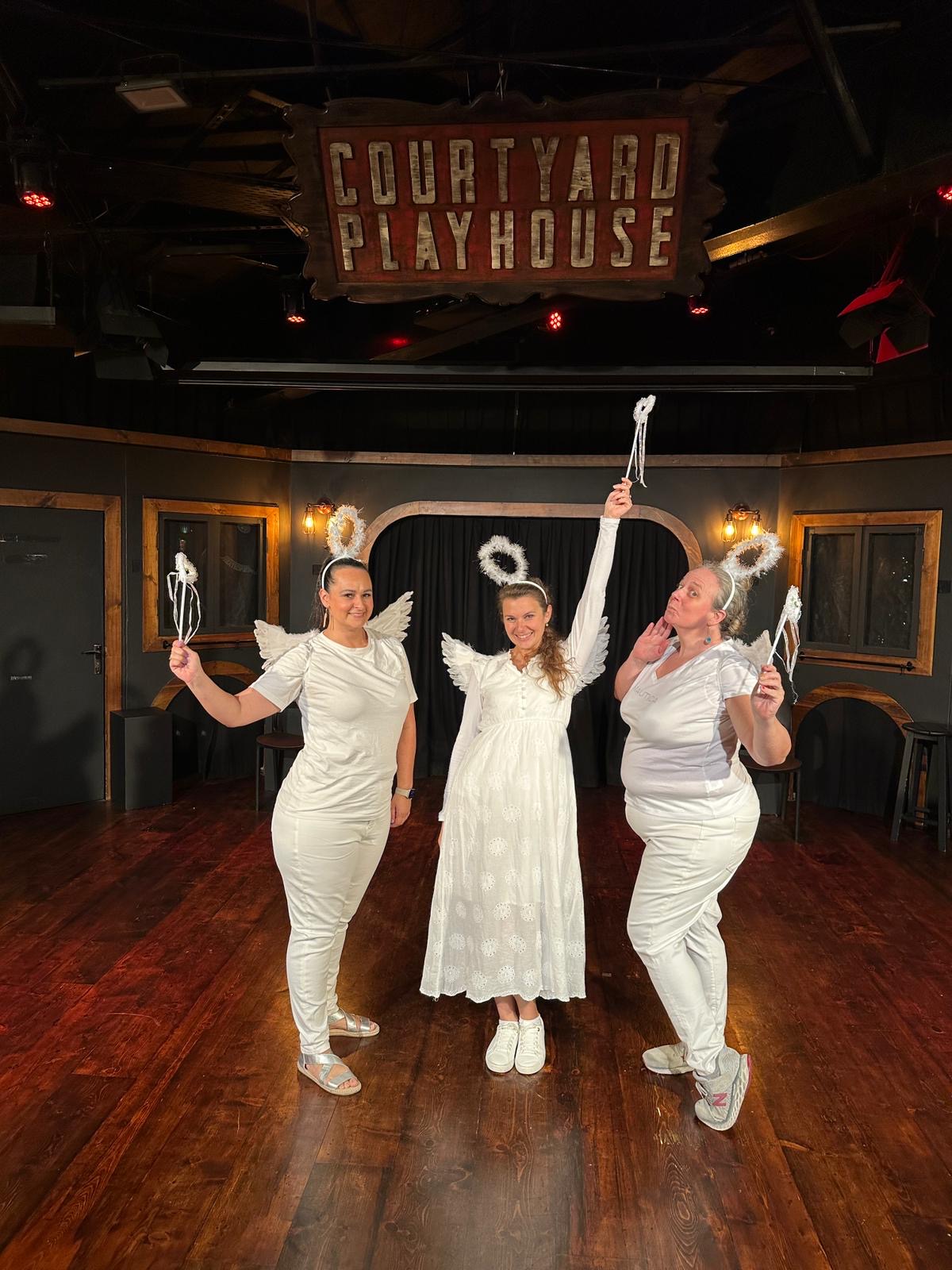
— Healing Through Improv
-By Solène Anglaret
Trigger warning: This article discusses mental health struggles, including suicidality. Please take care of yourself while and after reading it. Feel free to pause at any point.
I’ll never forget my first showcase at The Courtyard Playhouse. Standing under the lights, mid-performance, I was struck by an unexpected realisation: this is home.
Losing Creativity (and Myself)
As a child, I was very creative. I wrote, drew, danced, performed, and dreamed of one day becoming a TV reporter and presenter. But as I grew older, I was encouraged to take a more “responsible” path, and my desire to perform was judged. I, too, started to wonder: why did I want to do this? Was I just attention-seeking?
Bullying at school shattered my sense of self, and after a single year of theatre as a teen, I walked away from the stage. I studied political science and international relations and built a corporate career instead. But creativity never disappeared entirely. At one point, my colleagues even nicknamed me “the ideas machine”.
When I moved from China to Australia in 2018, I gave my creative side another chance. I wrote and published my first book, took on random acting gigs – from Neighbours extra roles to a TEDx – and felt alive again. But financially, I couldn’t sustain it. So, after a year, I returned to a corporate job, proceeding to convince myself this was proof I wasn’t talented enough and should stop pursuing this path and give it up forever. Done. Dusted.
Cutting ties with creativity left me empty, and my mental health progressively took a dark turn. Over the course of the following couple of years, I gradually spiralled into despair and suicidality. At the time, I didn’t see the link between losing my creative self and my will to live.
Rediscovery and Recovery
Eventually, I was diagnosed with Borderline Personality Disorder (BPD) and later Attention Deficit Hyperactivity Disorder (ADHD). Alongside a year-long Dialectic Behavioural Therapy (DBT) programme, a big part of recovery was reconnecting with my curiosity and creativity. It started with writing daily, then painting, and eventually making my first short film: Still Here?
The idea for Still Here? was born on a treadmill as I watched a motivational video. I realised that, for someone like me at the time, who found themselves deep in despair, it wasn’t cutting it. I thought… we need to create a resource for people who feel lost and alone, something that helps them (and me…) to remember what makes their life worth living.
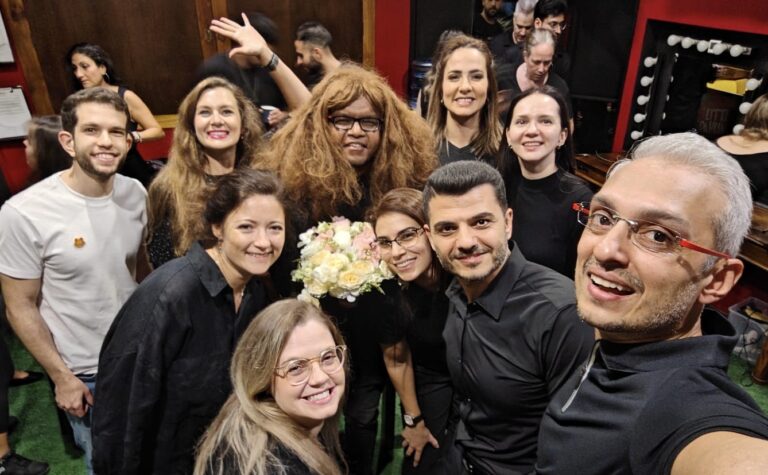
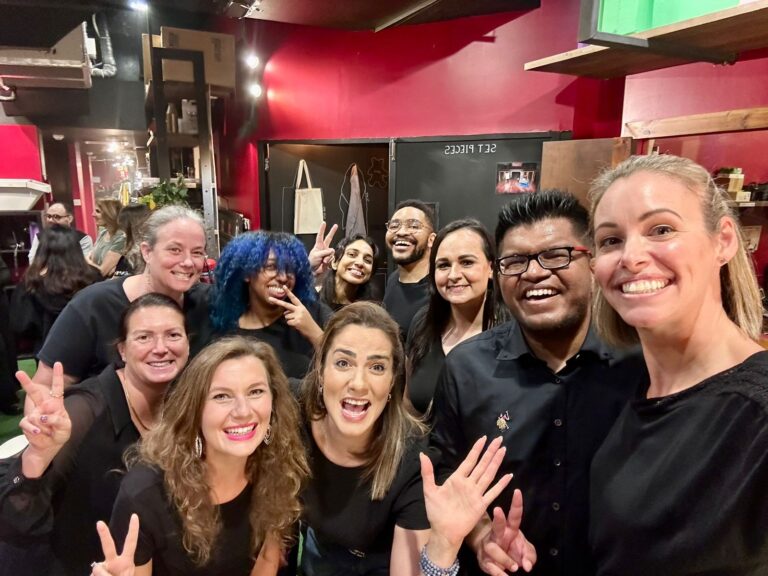
Working on that project reignited a spark and, as soon as I moved to Dubai, I decided to pursue acting and theatre again. Within the first few weeks, I stumbled upon The Courtyard Playhouse and signed up for a trial class. What immediately struck me was the vibe of the place, particularly the kindness and warmth of the team.
Since then, I’ve taken various classes (Don’t Panic, Technique, Desert Monologues, and Storytelling), performed at Maestro, Spotlight, SuperStory, and loved every minute and opportunity!
What Improv Taught Me
Improv has taught me lessons that extend far beyond the stage. Here are a few that are particularly relevant to the topic of mental health:
Embrace your creativity → Improv taught me there truly is no right or wrong. In class and on stage, all creative ideas are welcome, and failing doesn’t mean you are a failure. Volunteering at Maestro took it one step further and showed me that failing is fun!! What a perspective shift for a perfectionist like me (still working on it!) … Improv has given me the chance to let go and enjoy the process – at the theatre and in life.
Practice mindfulness → Improv requires presence. In class, the two hours vanish in a heartbeat, and my first 30-minute showcase felt like 5 minutes. For that time, outside worries and inner dark thoughts disappear. It’s a form of mindfulness in motion.
Express your emotions → Contrary to what we often think, acting and performing aren’t about pretending or becoming a character. They’re an invitation to bring our own emotions and stories to the surface. At a storytelling workshop recently, I found myself crying on stage – something I absolutely never thought I’d do. It was surprisingly powerful and healing, proving that theatre can be a safe space to process and express all emotions, whether it’s joy and laughter or vulnerability and tears.
Be yourself → By trying different games, genres, teaching styles, etc., improv gives you the opportunity to figure out who you are and what you love most as a performer. After years of struggling with my sense of identity, joining the theatre (alongside therapy too!) has led me to reconnect with my love of writing and performing spoken word poetry.
Listen and connect → Improv requires deep listening – not just waiting for your turn to speak, but really tuning in. That builds connection, both on stage and off. Through the Courtyard Playhouse, I’ve met fellow neurodivergent people, formed friendships that extend beyond the theatre, and found a sense of belonging.
Why Creativity Matters for Mental Health
Truth is, you don’t need money, talent, or success to justify pursuing your creativity in any shape or form. If you enjoy it, that’s reason enough to do it! Plus, creativity and expression help with our mental health and wellbeing. So, why not go for it?
Research agrees. Psychodrama, pioneered by Jacob Moreno, uses role play and improvisation to help people process emotions and gain perspective. More recent studies on improv show it reduces anxiety, boosts resilience, and strengthens social connection. Across the arts, research confirms creative expression lowers stress and supports recovery.
For me, creativity on and off-stage has been a lifeline. It has saved me from me, truly.

Improv Your Mental Health Conversations
That is why I’m so grateful and excited to be collaborating with The Courtyard Playhouse on an upcoming event: Improv- Your Mental Health Conversations on Saturday, 15th November from 7 to 8:30pm.
The evening will begin with the Dubai premiere of my award-winning short film Still Here?, followed by an interactive session exploring how improv principles can help us talk more openly about mental health. You’ll even get the chance to try a few simple exercises from the comfort of your seat.
Our aim is simple: to help you feel more comfortable having mental health conversations, to share lived experience, and to leave you with practical tools you can use every day.

Solène Anglaret
Solène Anglaret (she/her) is a Consultant, Coach, and Creative with 15 years of international experience across seven countries. She founded Be Beyond Borders after a career in corporate and government organisations. As a consultant, she helps organisations navigate culture change and become more accessible and inclusive. As a coach, she supports individuals through major career and life transitions. And, as a creative, she has authored five books, released an award-winning short film, and performed at shows and events worldwide. Named one of the 133 Women Who Change the World and a Top 50 most influential neurodivergent woman in the UK, Solène draws on her lived experience of BPD and ADHD to support, inspire, and advocate for others.